
What is the bile duct? The liver continuously produces bile, a digestive fluid that helps us break down and digest fats. Bile travels from the liver through small microscopic channels that join together to form a central tube called the bile duct. The bile duct carries this bile directly into the small intestine.
Gallstones usually form inside the gallbladder. Sometimes, however, a stone can slip out of the gallbladder and move into the main bile duct. Medical professionals call this a common bile duct stone (CBD stone).
Why Can Bile Duct Stones Become a Problem?
A very small stone may occasionally pass into the intestine on its own without causing symptoms. However, if a stone gets lodged or stuck in the narrow bile duct, it blocks the normal flow of bile. This blockage can rapidly lead to serious medical complications:
A blocked and infected bile duct can quickly become a serious medical emergency and requires prompt, expert gastroenterological treatment.
How Are Bile Duct Stones Usually Removed?
The most commonly used procedure for removing bile duct stones is ERCP (Endoscopic Retrograde Cholangiopancreatography).
During ERCP, a flexible endoscope is passed through the mouth into the intestine. The opening of the bile duct is identified and accessed with specialized instruments. The stone can then be removed using balloons, baskets, and other devices. For most bile duct stones, conventional ERCP works very well.
However, some stones are difficult. They may be:
- Very large: Exceeding standard duct extraction diameters.
- Hard: Resistant to standard mechanical retrieval.
- Impacted or tightly stuck: Wedged firmly in the bile duct lumen.
- Multiple: Stacked within the duct system.
- Located in a difficult part: Higher up in the biliary tree.
- Difficult to capture: Slipping away from standard baskets or balloons.
In such situations, additional specialized endoscopic techniques are required.
What Is Cholangioscopy?
Cholangioscopy is a technique that allows the doctor to directly see inside the bile duct.
Think of the bile duct as a narrow pipe. With conventional ERCP, doctors mainly use X-ray images to understand what is happening inside this pipe.
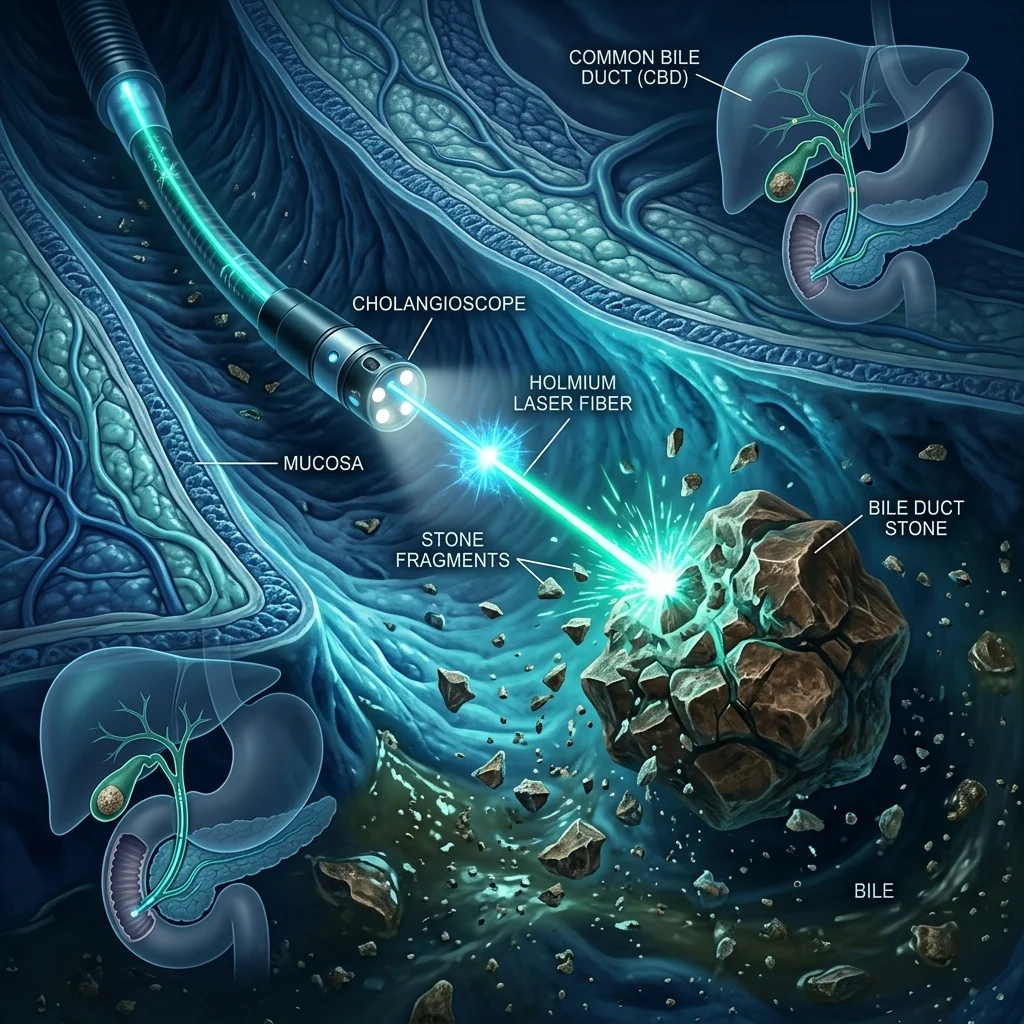
With cholangioscopy, a very small camera is introduced into the bile duct. It provides a direct, high-definition view of the bile duct, the stone, and the surrounding tissue.
This direct view makes difficult cases much easier to understand and treat safely.
How Does Laser Lithotripsy Help?
Sometimes a stone is simply too large to remove in one piece. In these situations, laser lithotripsy can be used.
A very thin laser fiber is introduced through the cholangioscope. Under direct visualization, the laser is used to break the large stone into smaller fragments. The smaller pieces can then be removed using conventional endoscopic techniques.
This technique can be particularly useful for selected patients with large or difficult bile duct stones.
Is Cholangioscopy Only Used for Stones?
No.
Cholangioscopy can also have an important role in evaluating certain bile duct strictures. A bile duct stricture means that part of the bile duct has become unusually narrow. There can be several causes, including inflammation, previous procedures, and cancers.
In selected cases, cholangioscopy allows the doctor to directly examine the abnormal area and obtain targeted tissue samples (biopsies). This can help doctors determine the cause of an uncertain bile duct abnormality.
Is Cholangioscopy an Alternative to Surgery?
Not necessarily.
Cholangioscopy is an advanced endoscopic treatment option for selected patients. Many bile duct stones can be successfully treated with conventional ERCP alone. Some difficult stones may benefit from cholangioscopy-guided lithotripsy.
However, there are situations where surgery remains the most appropriate treatment. The decision depends on:
- Size and number of stones
- Location of the stones
- Anatomy of the bile duct
- Previous procedures
- Gallbladder condition
- Overall health of the patient
- Experience and availability of appropriate expertise
Therefore, cholangioscopy should be viewed as another tool in the treatment of difficult biliary disease, rather than a replacement for surgery in every patient.
Is Cholangioscopy Safe?
Like any medical procedure, cholangioscopy has potential risks. Because it is generally performed along with ERCP, risks can include:
- Pancreatitis
- Infection
- Bleeding
- Perforation
- Problems related to sedation or anesthesia
The overall risk depends on the patient's condition and the complexity of the procedure. Your gastroenterologist will discuss the potential benefits and risks before the procedure.
What Happens During the Procedure?
Cholangioscopy is usually performed as part of an ERCP procedure. In simple terms:
Step 1: Sedation or Anesthesia
The patient is given appropriate sedation or anesthesia to remain relaxed and comfortable.
Step 2: Endoscope Insertion
An endoscope is passed through the mouth into the small intestine.
Step 3: Accessing Bile Duct
The bile duct opening is accessed using specialized instruments.
Step 4: Cholangioscope Introduction
A thin cholangioscope is introduced directly into the bile duct.
Step 5: Direct Visualization
The doctor directly visualizes the stone or abnormal area in high definition.
Step 6: Laser Lithotripsy
If required, laser or another lithotripsy technique is used to fragment a difficult stone.
Step 7: Fragment Removal
The stone fragments are removed using standard endoscopic tools.
Step 8: Stenting & Completion
In some cases, a temporary bile duct stent is placed and the procedure is completed in stages. Not every patient requires all of these steps.
Does Every Large Bile Duct Stone Need Cholangioscopy?
No. This is an important point.
Cholangioscopy is an advanced technique, but it is not automatically required whenever a bile duct stone is large. Many stones can still be removed safely using conventional ERCP techniques.
Cholangioscopy is considered when the treating team believes that direct visualization and intraductal lithotripsy could improve the chances of successful treatment.
Frequently Asked Questions
No. Cholangioscopy is a minimally invasive, endoscopic procedure performed through the mouth without any surgical cuts or external incisions.
When performed alongside ERCP and laser lithotripsy, the procedure typically takes 45 to 90 minutes depending on the size and complexity of the stone.
No. The entire procedure is performed under appropriate sedation or anesthesia, ensuring complete comfort and pain relief throughout.
No. Cholangioscopy targets stones in the common bile duct. Gallstones remaining in the gallbladder are treated through gallbladder surgery (cholecystectomy).
Yes. Cholangioscopy-guided lithotripsy for difficult bile duct stones is available at our centre in Siddaganga Hospital, Tumakuru under Dr. Bala Krishna A.
What Should You Do If You Have a Bile Duct Stone?
If you have been diagnosed with a bile duct stone, don't worry simply because the stone is described as “large” or “difficult.” There are several treatment options available today.
A gastroenterologist experienced in ERCP and advanced biliary endoscopy can assess the stone and decide whether conventional ERCP, cholangioscopy-guided lithotripsy, surgery, or a staged approach is most appropriate.
The Important Message: Not all bile duct stones are the same. Most can be treated successfully with conventional ERCP. For selected difficult stones, modern techniques such as cholangioscopy-guided laser lithotripsy can provide another minimally invasive treatment option.
Advanced Biliary Endoscopy Now Available in Tumakuru
For selected patients with difficult bile duct stones, cholangioscopy-guided lithotripsy is now available at our centre in Tumakuru.
Dr. Bala Krishna A, MBBS, MD, DM
Consultant Gastroenterologist & Interventional Endoscopist
* This article is intended for general education and does not replace an individual medical consultation. The appropriate treatment depends on each patient's clinical condition and imaging findings.